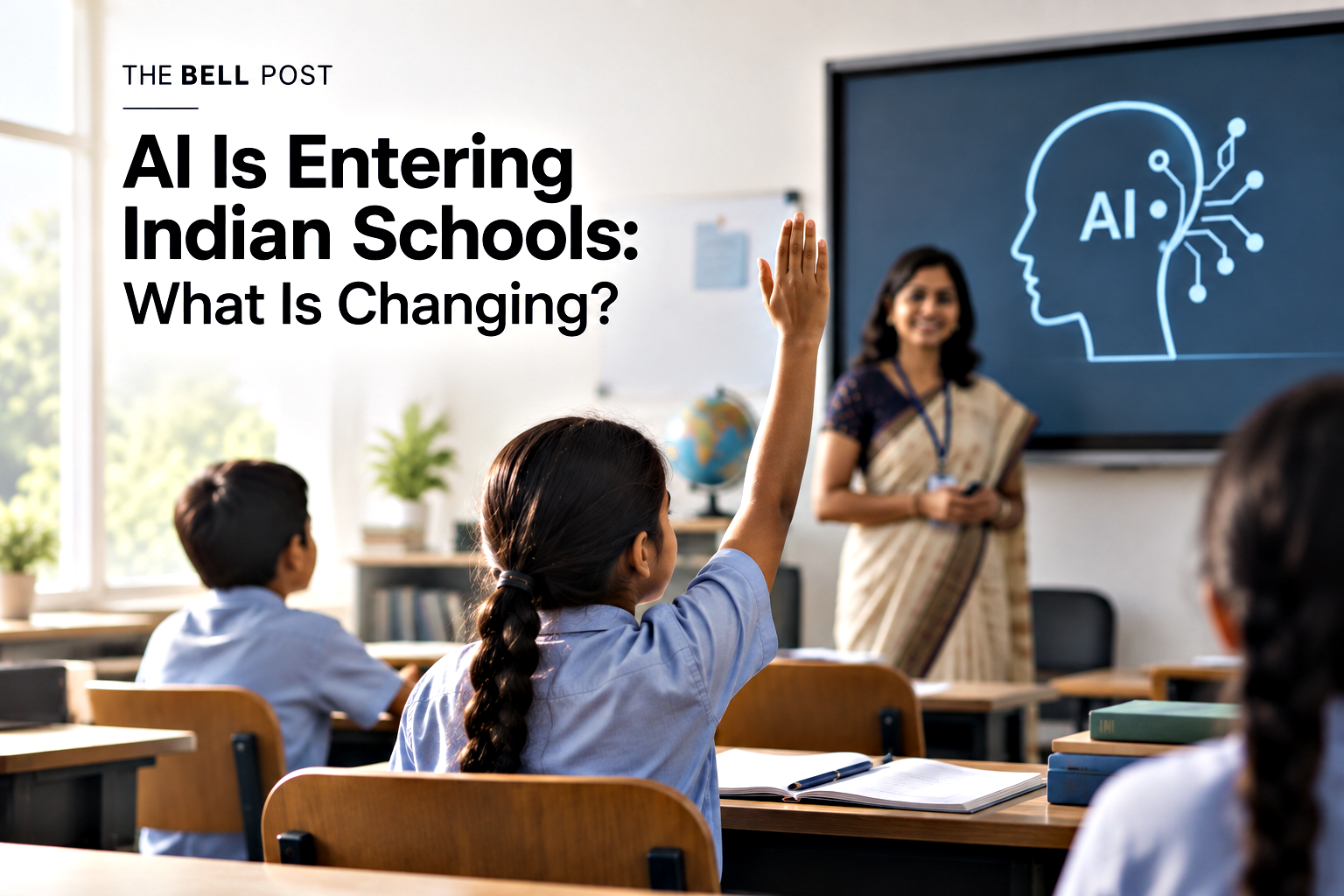
There is no single AI curriculum in Indian schools. Instead, artificial intelligence is arriving through several routes at once: board curricula, state programs, national skilling initiatives and school innovation labs.
CBSE has introduced Computational Thinking and Understanding Artificial Intelligence for Classes 3 to 8, starting in the 2026-27 academic session. CISCE has added Robotics and Artificial Intelligence at the ICSE level, plus a full Artificial Intelligence subject at the ISC (senior secondary) level. Tamil Nadu is running its own program, TN SPARK, in 3,000 government schools. And the Union government's SOAR initiative offers AI-readiness courses to students and teachers across the country.
Two students in two different schools, even in the same city, may end up learning AI in almost entirely different ways.
This is bigger than ChatGPT
Ask most parents what "AI in schools" means and they'll probably picture a student using ChatGPT to write an essay, or an image generator for a project poster. That does happen. But it's a small part of a much bigger shift.
Depending on a student's age and board, AI education can include computational thinking, data and algorithms, coding, pattern recognition, robotics, project-based learning, and lessons on ethics, bias and digital responsibility. UNESCO's AI Competency Framework for Students takes a similar view, built around a human-centred mindset, ethics, technical understanding and system design, with students progressing from simply understanding AI to applying and eventually creating with it.
So the real question schools are trying to answer isn't just "can a student use AI." It's whether a student understands what the AI is actually doing, and whether they know when to question its answer.
Why now?
AI itself isn't new. What's changed is how visible and unavoidable it has become. Students now run into it through search engines, recommendation feeds, voice assistants, translation apps and generative AI tools, often before anyone has taught them how any of it works.
That's pushed schools toward a broader goal: not just teaching students to use technology, but helping them understand its limits and its consequences. CBSE's current curriculum push is explicitly tied to the National Education Policy 2020 and the National Curriculum Framework for School Education 2023, so this isn't happening in isolation from broader policy.
What it isn't, though, is uniform. Here's how it's actually playing out across four different tracks.
1. CBSE: computational thinking from the middle-school years
CBSE's Computational Thinking and Understanding Artificial Intelligence curriculum for Classes 3 to 8 launches with the 2026-27 academic session. According to CBSE, the goal is to build students' ability to think logically, solve problems step by step, spot patterns, and understand how AI should and shouldn't be used. The board has also made this the theme of its teacher training for 2026-27.
The progression is deliberately gradual. For Classes 3 to 5, computational thinking is woven into Mathematics and "The World Around Us" rather than taught as a standalone tech subject. For Classes 6 to 8, it shifts toward more formal computational thinking, introductory AI literacy and interdisciplinary projects, with an emphasis on data literacy, logic and ethics rather than on any particular app or device.
In practice, that means AI education for a seven-year-old doesn't start with programming a model. It starts with something simpler: how do you break a problem into smaller parts, and how do you spot a pattern?
We'll cover exactly what students will learn, year by year, in Post 2 of this series.
2. CISCE: robotics and AI through hands-on learning
CISCE has taken a more hands-on route. Its Robotics and Artificial Intelligence subject at the ICSE level covers both theory and practical work, with official material describing an emphasis on experiential, project-based learning across AI concepts, robotics, data and programming. CISCE has also published a teacher primer with sample activities and ideas for running Robotics and AI clubs.
At the senior-secondary level, CISCE goes further still, offering Artificial Intelligence as a full ISC subject for students who want a more structured, exam-based path into the field.
This is worth pausing on, because it shows AI education doesn't have to look the same everywhere. One board can start with computational thinking at age eight. Another can lead with robotics kits and programming at the secondary level. Both count as "AI education," and neither is the full picture on its own.
We'll go deeper on the ICSE and ISC approach in Post 4.
3. Tamil Nadu: AI in government-school classrooms
Tamil Nadu's approach is arguably the most ambitious in scale. TN SPARK (the Tamil Nadu School Program for AI, Robotics and Knowledge of Online Tools) is a pilot by the state's Department of School Education, SCERT and Samagra Shiksha, launched in the 2025-26 academic year. According to the program's official site, it's designed to bring AI education into Classes 6 to 9 across 3,000 government schools that already have functional Hi-Tech Labs, using infrastructure the state had already built rather than starting from scratch.
The curriculum itself is broad: computer science fundamentals, AI applications, generative AI, text-to-image tools, speech synthesis, visual programming, Python, cyber safety and digital ethics. The stated goal is to widen access to AI education and narrow the digital divide for students in government schools specifically, not just in well-resourced private ones.
That framing matters. It puts AI education in front of students who might otherwise have had no exposure to it at all.
Post 3 will look at TN SPARK in detail and what it means on the ground.
4. National programs: AI learning outside the regular timetable
AI education isn't confined to board curricula either. The Government of India's Skilling for AI Readiness (SOAR) program was launched to build foundational AI awareness among learners and educators nationally. Its first phase offered four self-paced online courses: AI to be Aware, AI to Acquire, AI to Aspire, and AI for Educators, aimed at students in Classes 6 to 12 as well as teachers, covering AI fundamentals, generative AI, programming basics, ethics and cybersecurity.
The program has since grown. The government has said SOAR now spans 50 AI and AI-application-oriented qualifications, covering areas like AI for jobs, workplace productivity and sector-specific applications.
In other words, a student doesn't need AI to be a formal subject at their school to start building AI-related skills. It can happen alongside their regular education, through a national program most parents may not even know exists yet.
What happens inside an Atal Tinkering Lab
Atal Tinkering Labs, set up under the Atal Innovation Mission, exist to let students experiment, build and try to solve real problems rather than just study theory. As of June 2026, the government reported more than 10,000 ATLs across 722 districts, with 1.1 crore students engaged, working on projects that touch robotics, AI and IoT.
An ATL isn't an AI classroom in the traditional sense, and not every student there is building an AI model. What it does is put experimentation and technology in the same room, and let students ask a more useful question than "what is AI": can I use this to actually solve something, in healthcare, agriculture, accessibility or wherever they see a gap?
So what does "learning AI" actually mean?
It depends entirely on the student's age, board and program. Roughly, it breaks down like this:
Early years: patterns, sequences, logic, basic problem-solving
Middle school: data, algorithms, AI concepts, projects, ethics
Senior school: programming, data processing, AI applications, structured projects
Outside the classroom: generative AI, chatbots, image tools, AI-assisted learning
None of this is about turning every student into an AI engineer. It's about giving them enough understanding to use AI thoughtfully, question its answers, and participate responsibly in a world where the technology is already everywhere.
Teachers are part of this too
A school can buy every laptop and license every tool it wants, but none of it works if teachers aren't equipped to use it. Teachers now need to understand what AI can and can't do, how it can support learning, how to catch incorrect AI-generated answers, how assessment might need to change, how to protect student data, and just as importantly, when AI shouldn't be used at all.
CBSE has made this the focus of its 2026-27 teacher training, and SOAR includes a dedicated AI for Educators course. UNESCO's teacher framework covers similar ground: AI foundations, pedagogy, ethics, and professional development. The technology will keep changing quickly. A teacher's judgment about when and how to use it won't go out of date the same way.
The questions every school still has to answer
Can AI-generated information be trusted? Not automatically. AI systems can sound confident while being wrong.
What happens to homework? If a student can ask AI to write an essay in seconds, schools have to rethink how assignments actually measure understanding.
What about privacy? Schools need clear rules on what student information can and can't go into an AI tool.
What about bias? Students need to know AI systems can reflect the limitations and biases baked into their training data.
Will AI replace teachers? The frameworks driving all of this, from CBSE to UNESCO, are built around AI literacy and human judgment, not automation of the teacher's role.
What parents should actually be asking
"AI-enabled school" is going to show up in a lot of school brochures over the next few years, and on its own the phrase tells you almost nothing. A more useful set of questions:
What exactly do students learn, and at what age does it start?
Is the teaching theoretical, practical, or project-based?
Are teachers actually trained in this, or was a lab just installed?
Does the school have written guidelines for generative AI use?
How does it handle AI-assisted homework, and how does it protect student data?
Are students taught to check AI-generated answers, not just use them?
The label on the door matters far less than what's happening in the classroom.
The Bell Post takeaway
AI is entering Indian schools through several doors at once: board curricula, state programs, national skilling initiatives, teacher training and innovation labs. What a student actually experiences depends on their board, state, school and age, not on a single national standard.
For parents, that means looking past "AI-enabled" and asking what their child will really learn. For schools, the task is bigger than adding a new subject. It's preparing students to understand AI, question it, verify it, and use it responsibly, in a landscape that's still very much being built.