Every year, the government allocates funds towards elementary education across India. But how is this money distributed, what is it spent on, and how does the government track its use?
A Ministry of Education reply to a Lok Sabha question on 10 August 2026 provides details on state-wise allocations, expenditure on key school services and the collection and utilisation of education cess.
Here is what the data shows.
How are the funds allocated and released?
Under the Samagra Shiksha scheme, states and Union Territories prepare an Annual Work Plan and Budget (AWP&B) based on their needs and priorities. The Project Approval Board (PAB) reviews and approves these plans in consultation with the respective states and UTs.
However, approval does not automatically mean that the entire amount will be released immediately.
Fund releases depend on several conditions, including the pace of expenditure, receipt of the state's matching share, audited accounts, updated expenditure statements and utilisation certificates from the previous year. Unspent balances are also taken into account.
According to the ministry's reply, some states do not receive all their instalments because expenditure has progressed slowly.
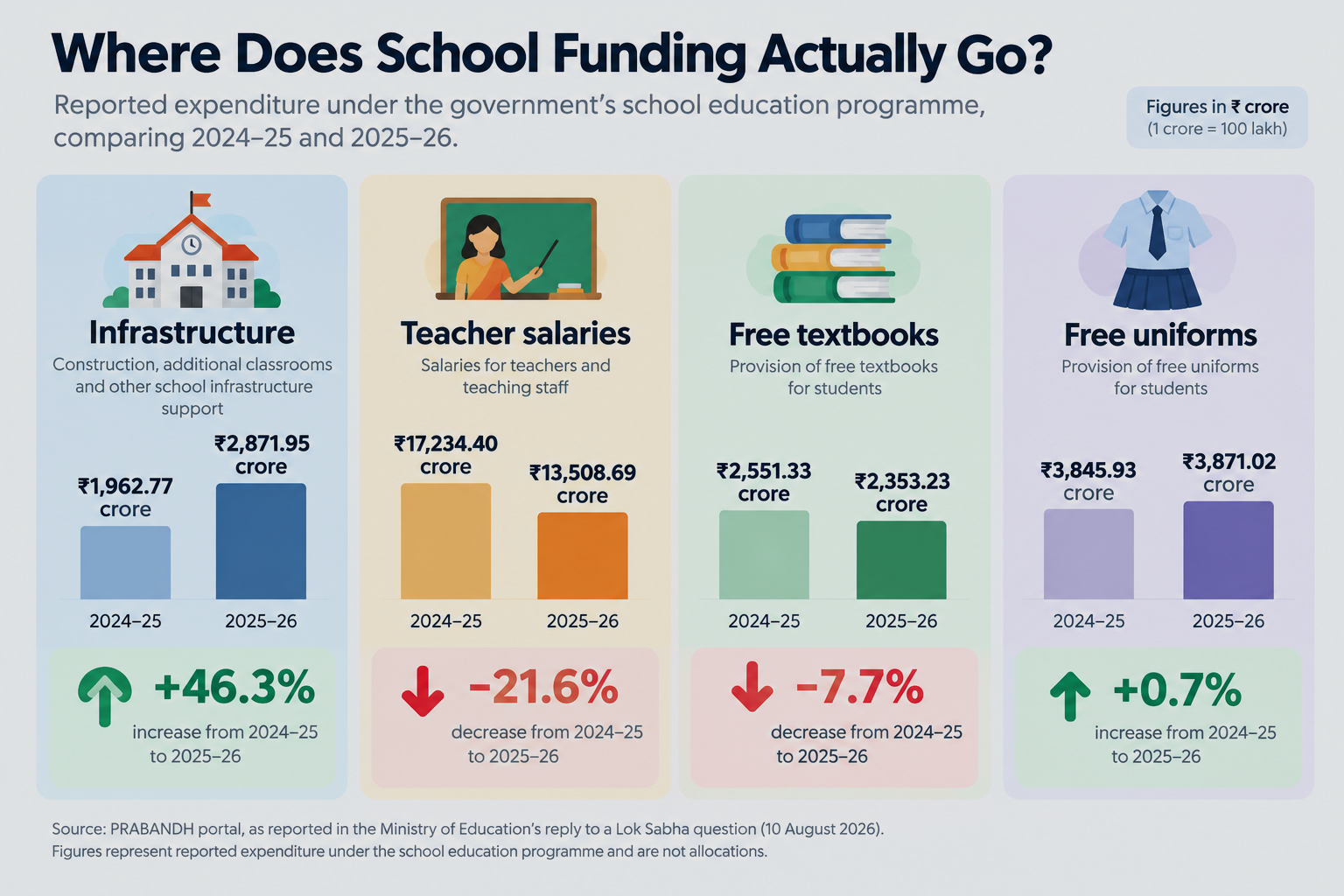
Where is the money being spent?
Where does education cess go?
The reply also provides figures on education cess, a levy collected for specified purposes under legislation passed by Parliament.
The government reported total education cess collections of ₹63,252.86 crore in 2024–25 and ₹65,890.50 crore in 2025–26, an increase of approximately 4.2%.
The reply separately reports utilization through two education reserve funds:
Reserve fund | 2024–25 | 2025–26 |
|---|---|---|
Prarambhik Shiksha Kosh (PSK) | ₹40,900.00 crore | ₹48,049.09 crore |
Madhyamik and Uchchtar Shiksha Kosh (MUSK) | ₹11,162.60 crore | ₹10,314.31 crore |
PSK is associated with elementary education, while MUSK supports secondary and higher education.
Reported utilization through PSK increased by approximately 17.5%, while utilization through MUSK declined by around 7.6%.
These utilization figures are separate from the state-wise Samagra Shiksha allocations. They should not be interpreted as a complete breakdown of total education cess collections.
How is spending monitored?
The Ministry of Education uses PRABANDH (Project Appraisal, Budgeting Achievements and Data Handling) to track expenditure under different Samagra Shiksha interventions.
Its dashboard displays monthly physical and financial progress. The ministry also conducts regular follow-ups and review meetings with states and Union Territories to monitor implementation.
This tracking system helps the ministry review both the progress of activities and the expenditure reported by states.
How much are states receiving?
The ministry's reply includes state- and Union Territory-wise allocations under Samagra Shiksha for four financial years, from 2023–24 to 2026–27.
The amounts vary across states and financial years. The annexure provides the detailed figures, allowing readers to check allocations for individual states and UTs.
View the complete state-wise allocation table in the official government release.
What does this mean for schools?
The figures offer a view of how elementary education funding is planned, released and monitored. They also highlight an important distinction: allocation and expenditure are not the same thing.
An allocation is the amount approved for a particular purpose or state, while expenditure records the amount reported as spent. Fund-release conditions and expenditure monitoring are additional parts of the process.
Understanding these differences helps readers put government funding announcements into context and follow how public money is being used across the education system.
Official source: Ministry of Education, Press Information Bureau, 10 August 2026