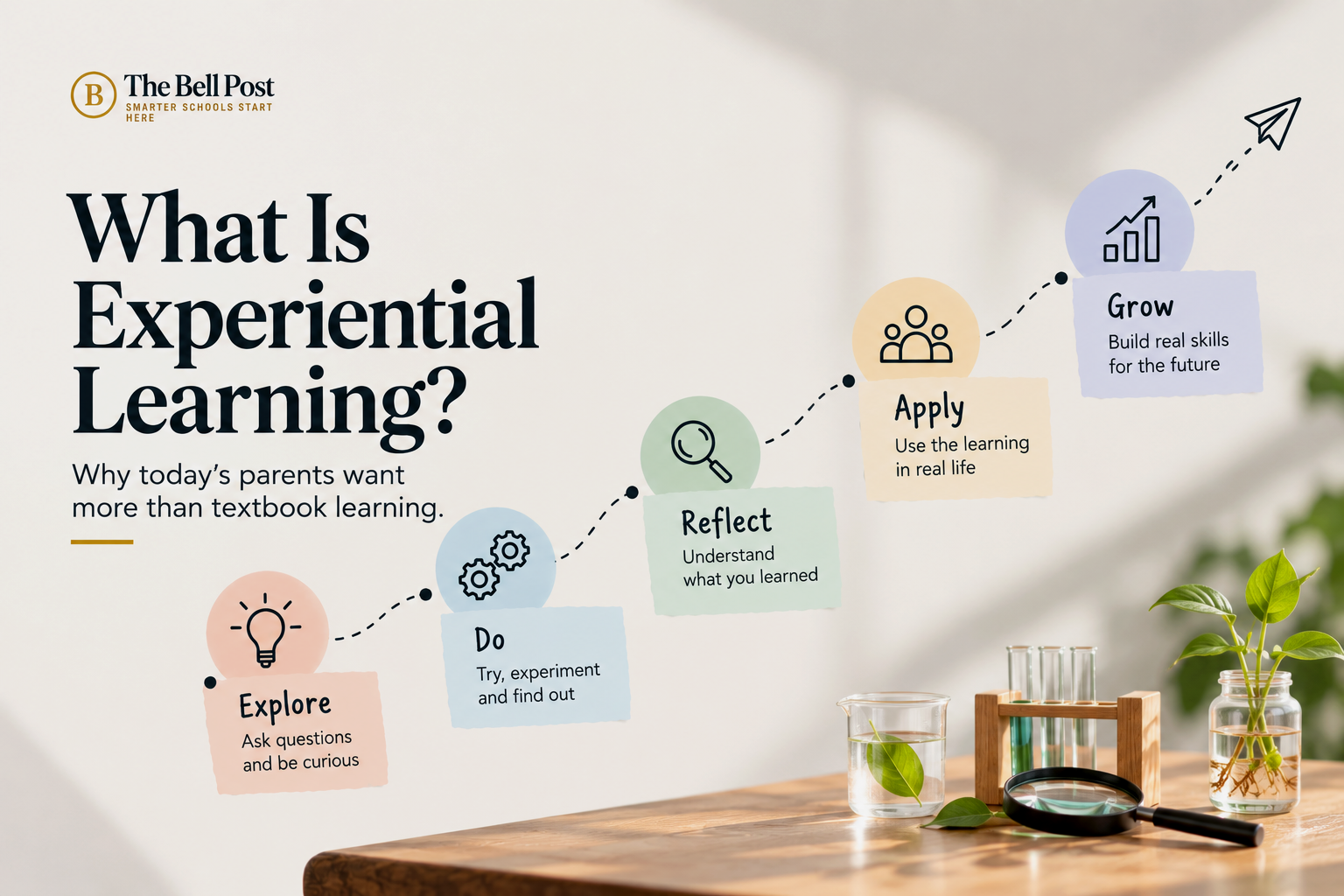
Experiential learning is learning by doing, exploring and reflecting on an experience, rather than just reading about a topic or memorizing an answer for an exam. Instead of only studying a concept, students get to experiment with it, work through a problem, and apply what they've learned somewhere real.
Most parents want their children to do well in exams. But plenty also want something exams can't fully capture: a child who can think independently, communicate confidently, solve problems on their own, and handle situations outside the classroom. That raises a fair question. Are students learning only to answer exam questions, or are they learning how to actually use that knowledge?
This is where experiential learning comes in.
"Learning is the process whereby knowledge is created through the transformation of experience."
— David A. Kolb, Experiential Learning
What does experiential learning look like in schools?
It doesn't require expensive equipment or special facilities. Often it's built into everyday classroom activities, just approached a little differently:
Science: running experiments and recording what actually happens, rather than just reading the expected result
Mathematics: planning a real budget and calculating real costs
Social science: studying a local community or interviewing people in it
Languages: writing and performing a play instead of only analysing one
Environmental education: identifying practical ways to cut waste at school
Take something as simple as plants. A student can grow seeds, watch how they develop, and record what happens under different conditions, learning the underlying science through direct observation instead of a textbook paragraph.
The activity itself is only half of it, though. Students still need to work out what they discovered and connect it back to what they're actually learning. Without that step, an activity is just an activity.
Why this matters to parents right now
Good marks still matter. But a growing number of parents want their children walking away with skills an exam alone can't really test for:
Problem-solving: working out a solution instead of memorising one
Communication: explaining an idea clearly and presenting their own work
Independent thinking: asking questions and actually examining the evidence
Teamwork: sharing responsibility and working alongside others
Practical application: connecting a classroom concept to an everyday situation
None of these develop from a single project. They build up over time, and well-designed learning experiences give students more chances to practice them.
Is experiential learning part of India's education policy?
Yes. The National Education Policy (NEP) 2020 explicitly encourages experiential learning, hands-on activities, and a shift away from rote memorization toward actual understanding.
There are also concrete changes landing in the 2026-27 academic year specifically. CBSE has made Kaushal Bodh, an activity-based skill-education textbook series, mandatory for Classes 6 to 8. The Ministry of Education has also built bagless days and other practical, off-textbook activities into skill education under Samagra Shiksha.
Together, these point to a real policy push to connect classroom learning with practical skill-building, though how well that plays out still depends a lot on individual schools.
Sources: CBSE Kaushal Bodh · Ministry of Education, Samagra Shiksha
What should parents actually look for?
A school doesn't need the latest technology or a fully equipped lab to offer meaningful experiential learning. What's worth looking for instead: chances for students to run experiments, work on projects with a real purpose, ask questions, explain their own reasoning, and learn from getting something wrong.
A simple way to check what's actually happening is to ask your child directly. What did you discover today? What problem did you solve? How would you actually use what you learned?
Those answers usually reveal more about the quality of a learning experience than just asking whether the homework got done.
The Bell Post takeaway
Experiential learning isn't about replacing textbooks or exams. It's about helping students connect what they learn with how they think, decide and solve problems.
For parents choosing a school, the real question isn't only how much a child studies. It's how much opportunity that child gets to understand, explore and apply what they're learning.
Because school should prepare a student not just to pass an exam, but to actually use what they've learned once they walk out of the classroom.